Dog Boarding Staff Qualifications: The Ultimate Parent’s Checklist for 2026
- May 29
- 12 min read
True luxury boarding is defined by the clinical and psychological expertise of the team, not just the size of a velvet suite. You might assume every person holding a leash is an expert in canine behavior, but the reality is that dog boarding staff qualifications vary wildly across the industry. It's a legitimate worry to imagine your beloved companion in a group play session where the staff might miss a subtle medical red flag or a sign of rising tension. With the 2026 legislative landscape shifting, such as the proposed NYS Safe Pet Boarding Act, the focus on professional standards has never been more critical for your peace of mind.
We know that leaving your pet is an act of profound trust, and you deserve to feel completely confident while you're away on a local mountain adventure or a long-awaited holiday. You want more than a simple kennel; you want a high-touch resort team that treats your dog as an honored guest. This guide will help you identify the gold standard in pet care staffing so you can enjoy your travels without a second thought. You'll learn the specific questions to ask during a tour, how to decode vague job titles, and how to spot a team that is truly invested in your dog's happiness and safety.
Key Takeaways
Identify the elite certifications that separate professional caregivers from basic handlers to ensure your dog receives expert-level attention.
Learn how advanced knowledge of canine psychology transforms group play into a safe, structured, and enriching social experience.
Discover the essential medical standards for dog boarding staff qualifications, including why universal CPR and First Aid training are non-negotiable for safety.
Use our ultimate parent’s checklist to verify staff-to-guest ratios and ensure total transparency during your dog's stay.
Understand how hospitality-based staffing models provide a more intimate, family-like environment compared to traditional industry containment.
Table of Contents
The Foundation of Professionalism: Essential Staff Certifications
A heart full of love is the beautiful, necessary baseline for anyone working with animals. However, in a high-end resort setting, love is simply the prerequisite, not the qualification. True peace of mind comes from knowing your family member is in the hands of a professional who has traded guesswork for science. As you evaluate dog boarding staff qualifications, look for a team that treats their role with the same gravity as a medical professional or a dedicated educator. In 2026, the difference between a simple stay and a restorative vacation lies in the specialized certifications the staff brings to the suite. While traditional boarding kennels might have once relied on seasonal help, today's elite facilities invest in rigorous, third-party validation to ensure every guest is safe and cherished.
The PACCC Standard: Why Third-Party Testing Matters
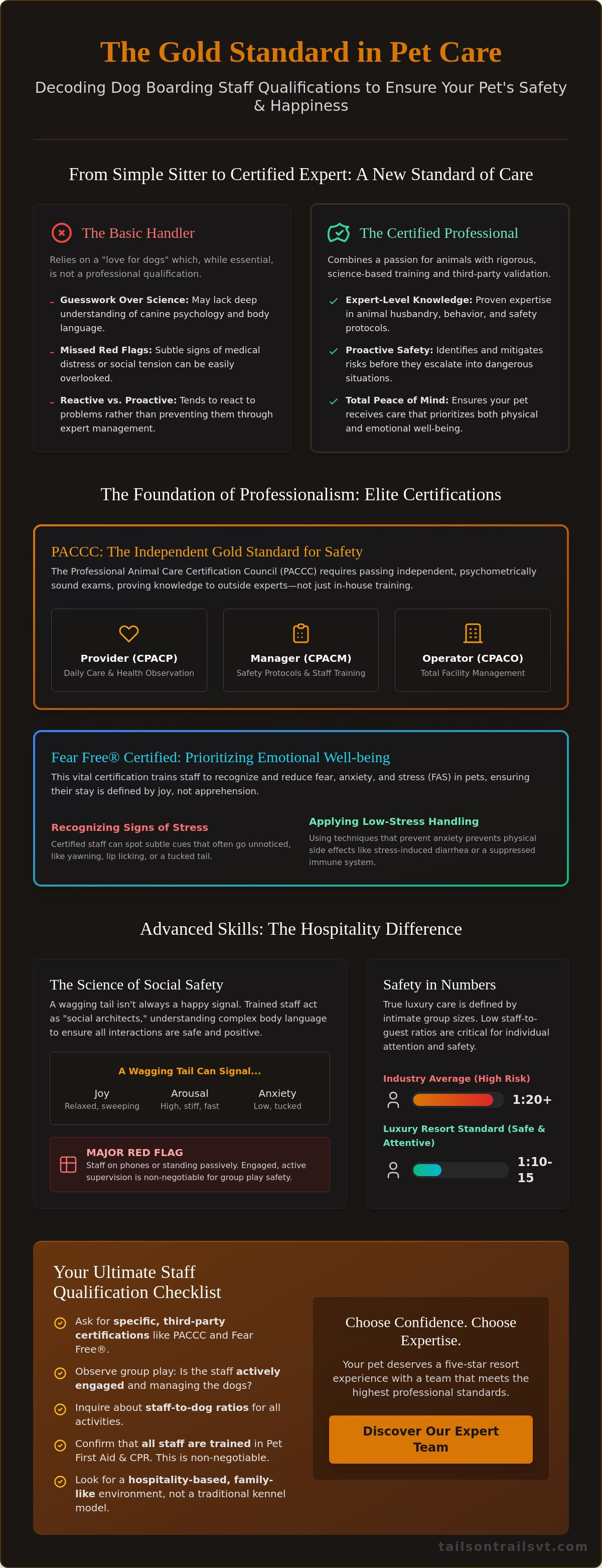
The Professional Animal Care Certification Council (PACCC) represents the pinnacle of industry standards. Unlike in-house training, which can vary in quality and depth, PACCC requires staff to pass independent, psychometrically sound exams. PACCC is the industry’s independent gold standard for safety. These certifications are divided into three distinct tiers: the Provider (CPACP) focuses on daily care and health observations, the Manager (CPACM) oversees safety protocols and staff training, and the Operator (CPACO) manages the entire facility's standards. When a caregiver is PACCC-certified, it means they've proven their knowledge in animal husbandry, behavior, and sanitation to an outside board of experts. It's the difference between someone who "knows dogs" and someone who understands the complex biological and psychological needs of a guest in a resort environment.
Fear Free Certification: Prioritizing Emotional Safety
Physical safety is only half of the equation; emotional well-being is just as vital for a happy stay. Fear Free certification trains staff to recognize and mitigate the subtle signs of stress, anxiety, and fear that can often go unnoticed. By utilizing low-stress handling techniques, certified caregivers can prevent the physical side effects of anxiety, such as stress-induced diarrhea or a suppressed immune system. This specialized training ensures that your dog's resort experience is defined by joy and relaxation rather than apprehension. It allows the team to adjust their approach for every individual, ensuring that even the most sensitive souls feel like they're in a safe, welcoming sanctuary.
Professionalism in 2026 also demands a commitment to continuing education. The science of canine behavior is constantly evolving, and a static team is a falling team. High-end facilities prioritize ongoing workshops and recertifications to stay ahead of the latest research. This dedication ensures that the dog boarding staff qualifications you see on paper translate into a sophisticated, high-touch service model where your pet’s happiness is the primary mission.
Advanced Training in Canine Psychology and Group Play
A wagging tail is often the most misunderstood signal in a social setting. While many assume it always indicates joy, it can actually signal anything from high-arousal excitement to a warning of impending tension. This is why dog boarding staff qualifications must go beyond a basic love for animals and delve deep into the sophisticated science of canine body language. In a resort environment, your dog isn't just "staying" in a room; they are navigating a complex social landscape. A qualified team acts as both a protective guardian and a social architect, ensuring that every interaction remains polite and restorative. When you tour a facility, look for caregivers who are actively engaged with the guests. If you see staff members on their phones or standing passively in a corner, it's a significant red flag that the safety of the group is being left to chance.
The ratio of staff to guests is just as vital as the training itself. Even the most expert caregiver cannot safely monitor thirty dogs at once. True luxury care is defined by intimate group sizes where every dog is known by name and personality. This allows the team to track individual energy levels and intervene the moment play starts to escalate. High-quality facilities often seek out independent staff certifications to validate that their team understands the nuances of pack dynamics and can maintain a peaceful, happy environment for every family member.
Mastering the Art of Dog-to-Dog Interactions
The primary goal of professional supervision is to identify "over-arousal" before it turns into a scuffle. Play should be a series of give-and-take movements, not a relentless chase. Qualified staff use specific protocols for introducing new guests to the pack, carefully matching them based on size, age, and temperament. We believe in enrichment-based play rather than mindless running. This approach focuses on mental stimulation and structured activities that leave dogs feeling satisfied and calm rather than physically exhausted and emotionally frayed.
Recognizing Anxiety and Stress Signals
Subtle cues like a quick lip lick, "whale eye," or sudden displacement sniffing are the early warning signs of a stressed guest. A professional team knows how to de-escalate these moments by offering a quiet "paws-up" break or a soothing one-on-one session. These psychological insights are the heartbeat of our enrichment services, ensuring that every activity is tailored to your dog's emotional needs. If your dog seems a bit overwhelmed by the group, our Dog Concierge can even arrange for more private, focused activities to ensure their vacation is entirely stress-free.
Safety and Medical Preparedness: The Non-Negotiables
Safety is the invisible thread of gold that runs through every high-end stay. It isn't enough to have a first-aid kit tucked away in a cabinet; every single caregiver must be a master of its contents. When you are assessing dog boarding staff qualifications, the clinical aspect of care should be your primary concern. A true resort treats medical preparedness as a non-negotiable standard, ensuring that 100% of the team holds current certifications in pet CPR and first aid. These certifications, which typically require renewal every two years, provide the foundational skills needed to act decisively in a crisis. By aligning with industry best practices, a professional team moves beyond simple supervision and into the realm of active medical vigilance.
There's a profound difference between a staff member who simply "administers meds" and one who practices clinical observation. The former follows a schedule, while the latter understands the pharmacology and potential side effects of the treatments they provide. You should feel confident that the team watching your family member knows exactly what to do if a local veterinary clinic is closed. A qualified resort will have clear, written emergency protocols that detail transportation plans and immediate triage steps, ensuring no second is wasted when it matters most.
Clinical Observation vs. Simple Supervision
Qualified caregivers are trained to spot the "silent" emergencies that can occur in a social environment. This includes recognizing the early, subtle signs of bloat, such as unproductive retching, or the initial stages of heat stroke before they become life-threatening. Documentation is key here. A professional team logs every meal, every movement, and every change in behavior, communicating these health checks to you with total transparency. A qualified staffer serves as the essential first responder for your pet, bridging the gap between the resort floor and the veterinary clinic.
Specialized Care for Senior and Post-Op Guests
For our older guests or those recovering from surgery, dog boarding staff qualifications must include specialized knowledge of mobility support and assistive devices. This is where the intersection of dog rehabilitation and standard care becomes vital. Staff members should be trained in orthopedic handling, ensuring that a senior dog is helped to their feet with grace and compassion rather than being rushed. When a resort employs a team trained in canine wellness and physical therapy, they can provide a level of sophisticated care that simple boarding facilities cannot match, turning a recovery period into a restorative retreat.
The Hospitality Difference: Evaluating the "Human" Element
While technical expertise is the backbone of safety, the soul of a true pet resort lies in its hospitality. In an elite setting, we move away from the clinical "handler" and "kennel" mindset. Instead, we embrace roles like "Caregiver" and "Dog Concierge." These titles reflect a high-touch service model where your dog is treated as an honored guest, not just another number in a system. When evaluating dog boarding staff qualifications, look for a team that balances professional rigor with heartfelt warmth. This "intuitive caregiver" approach means the staff isn't just following a checklist; they are actively listening to your dog's needs and adjusting their care to ensure a joyful, stress-free stay.
Transparency is the ultimate form of accountability. A professional team should be eager to share unedited updates and photos that show your pet's genuine experience. This openness builds a bridge of trust between you and the resort. Management must also have clear systems for monitoring performance, ensuring that the high standards promised are the standards delivered every single day. It's this dedication to the "human" element that transforms a simple stay into a bespoke vacation for your family member.
Communication as a Core Qualification
Expertise is often revealed in the details of a "Report Card." A high-quality update doesn't just say your dog had a "good day." It details specific social interactions, energy levels, and even dietary habits. This level of communication requires a staff that is trained in both observation and empathy. A Dog Concierge acts as your personal point of contact, handling your anxieties with the same professionalism they use to care for your pet. They are the advocates for your dog’s happiness, ensuring every request is met with a smile.
The Environment of Care: Sound, Smell, and Sight
A quiet facility is perhaps the most telling sign of highly qualified management. When staff are trained in "serene" environment protocols, they manage sound and scent to keep stress levels low. This might include using calming pheromones or playing curated music designed for canine ears. Cleanliness is also a reflection of staff discipline. A spotless, fresh-smelling resort isn't just about aesthetics; it's a sign of a team that is meticulous in their protocols and uncompromising in their dedication to your pet's health and comfort. If you're ready to experience this level of dedicated care, we invite you to book your dog's next luxury stay with us.
The Ultimate Staff Qualification Checklist for Pet Parents
Choosing a resort for your family member is one of the most important decisions you'll make. It's about more than a cozy bed; it's about the hands that will hold the leash. While the physical environment of a resort might look stunning, the clinical and psychological expertise of the team ensures your dog's safety. To help you navigate your options, we've compiled a concrete checklist to verify dog boarding staff qualifications before you commit to a stay. Use these steps to move beyond the marketing and into the heart of the care model.
Step 1: Ask for the ratio of PACCC-certified staff on every shift. Luxury care means the caregivers on the floor are experts, not just the manager in the back office.
Step 2: Verify that 100% of the team is CPR and First Aid certified. Don't settle for "most" of the staff; emergencies don't wait for the right person to be on the clock.
Step 3: Inquire about the specific group play training protocol used. Ensure the facility uses positive, enrichment-based methods rather than outdated dominance-based techniques.
Step 4: Ask how "stress red flags" are documented and reported. You should receive a digital trail or a detailed report card that tracks your dog's emotional health.
Step 5: Check for specialized credentials. If your pet is a senior or recovering from surgery, look for staff with training in canine wellness or physical therapy.
Touring the Facility: What to Look for in Real-Time
When you walk through the doors, observe the team's energy. Are they proactive? A proactive caregiver moves before a scuffle starts, gently redirecting energy. Listen to the volume of the facility. Constant barking is often a sign of high stress and poor management. Don't be afraid to ask a surprise question during your tour. Ask, "What is your protocol for a dog showing displacement behavior?" A qualified staffer will immediately mention signs like excessive sniffing or yawning and explain how they de-escalate the situation to keep the guest comfortable.
Final Decision: Trusting Your Gut and the Data
Trust your gut. If the "vibe" feels off, it usually is. However, back that feeling up with hard data and certifications. A sophisticated blend of luxury and expertise is the hallmark of a premier establishment. We believe that every dog deserves a vacation that is as safe as it is joyful. At Tails On Trails Pet Resort, we prioritize these high standards because your pet isn't just a client; they are part of our local family. We invite you to book a tour to meet our certified care team today and see the hospitality difference for yourself.
Elevate Your Standards for Your Dog’s Next Retreat
Choosing the right environment for your family member is about more than just a beautiful suite; it's about the expertise of the people inside it. You now have a clear path to evaluate dog boarding staff qualifications by looking for third-party certifications and a deep understanding of canine psychology. A true resort environment replaces basic supervision with clinical observation and heartfelt hospitality. By prioritizing PACCC-aligned training standards and a Fear Free certified environment, you ensure your dog’s vacation is as safe as it is joyful. Whether your pet needs the specialized attention of our on-site Canine Wellness Center or just a serene place to rest, the right team makes all the difference.
Don't settle for anything less than the gold standard in pet care. Your peace of mind is worth the extra due diligence, and your dog will thank you for the extra layer of security. We invite you to Experience the Peace of Mind of Professional Care at Tails On Trails. We can't wait to welcome your dog into our family for their next restorative stay.
Common Questions About Pet Care Excellence
What is the most important certification for a dog boarding staff member?
The gold standard for any pet care professional is the Certified Professional Animal Care Provider (CPACP) designation from PACCC. This independent certification ensures that a caregiver has mastered animal husbandry, health, and behavior through rigorous, third-party testing. It moves beyond simple enthusiasm and proves a deep, science-based understanding of safety protocols that protect your family member during their stay.
How many staff members should be present for a group of 15 dogs?
For a group of 15 dogs, industry best practices suggest at least one highly trained caregiver, though a more intimate ratio is always preferred for high-energy play. In a resort setting, we believe smaller groups allow for better supervision and more personalized engagement. This ensures every guest receives the individual attention they deserve while maintaining a serene and manageable social atmosphere.
Do boarding facilities require staff to have a degree in animal science?
While a degree in animal science is a wonderful asset, it isn't a legal requirement for most facilities in the United States. Specialized certifications and hands-on experience in canine psychology are often more practical for the daily nuances of resort care. We look for a blend of academic knowledge and proven skills in recognizing subtle body language to ensure a safe, happy environment.
What should I do if a facility won’t show me their staff training manuals?
Transparency is a cornerstone of trust, so a refusal to share training protocols is a significant red flag for any pet parent. A professional resort should be proud of their dog boarding staff qualifications and eager to explain how they prepare their team for daily care. If they are secretive, it's best to look for a facility that welcomes your questions with open arms and total honesty.
Is "Fear Free" certification different from standard dog training?
Yes, Fear Free certification focuses specifically on the emotional well-being and stress reduction of the animal rather than just basic obedience. It teaches staff to recognize "micro-signals" of anxiety and use low-stress handling techniques to prevent fear. This specialized training ensures that your dog's stay feels like a restorative vacation rather than a stressful event, prioritizing their mental health at every turn.
How often should pet resort staff renew their CPR certifications?
Pet first aid and CPR certifications should be renewed every two years to ensure life-saving skills remain sharp and current. This regular training keeps the team prepared for the unexpected with the latest clinical techniques and emergency protocols. At a high-end facility, you should expect 100% of the care team to be current on these essential safety standards for your total peace of mind.
Can staff handle dogs with medical conditions or post-op needs?
Qualified staff can certainly manage medical needs, provided they have specific training in clinical observation and medication administration. For post-op guests, it's vital to choose a resort with a dedicated Canine Wellness Center on-site. Our team is trained to handle mobility aids and monitor recovery signs, ensuring your dog receives sophisticated, empathetic care during their healing process in a comfortable, domestic setting.
What is a "Dog Concierge" and how does it differ from a kennel tech?
A Dog Concierge is a high-touch service professional who manages your pet's entire experience and serves as your personal point of contact throughout their stay. Unlike a traditional kennel tech, the Concierge focuses on bespoke enrichment and seamless communication with pet parents. This role elevates dog boarding staff qualifications by adding a layer of sophisticated hospitality to expert animal care, making the experience truly exclusive.


Comments