How Professional Daycares Handle Difficult Dogs: A Guide to Safety and Stress-Free Care
- Jun 29
- 12 min read
What if the dog you've labeled as "difficult" is actually just a sophisticated guest waiting for a more refined environment? It's a heavy burden to carry the guilt of leaving a high-needs pet, especially when you're anxious about potential injuries or the stinging label of "aggressive." You want your dog to feel like family, not a problem to be solved. Understanding how daycares handle difficult dogs starts with realizing that "difficulty" is often just a mismatch between a dog's unique personality and a chaotic, "free-for-all" setting.
We're here to offer you total peace of mind. You'll discover the high-touch protocols and behavioral science that elite resorts use to create a sanctuary for every temperament. We will dive into professional de-escalation techniques and the vital role of enrichment services in reducing stress. From the importance of a one to fifteen staff-to-dog ratio to the latest safety standards like those seen in Massachusetts' recent legislation, you'll learn how to identify a true canine wellness center that treats your dog with the hospitality they deserve. Your pup's next stay should feel like a vacation, not a source of stress.
Table of Contents
Defining "Difficult" in a Professional Daycare Setting
Your beloved companion isn't a "problem" to be solved; they're a guest with specific preferences. In many standard environments, a dog who struggles is quickly labeled as "bad" or "aggressive." However, true professionals understand that behavior is communication. When looking at how daycares handle difficult dogs, the first step is stripping away the labels and looking at the biology. Most dogs aren't inherently difficult. They're often just socially mature adults who no longer enjoy the chaotic "puppy party" atmosphere found in a traditional Dog daycare facility.
Environmental triggers play a massive role in how your dog presents. A dog who is perfectly social at a local park might feel overwhelmed in a high-density resort. This isn't a character flaw. It's often a sign of social maturity. As dogs age, they naturally become more selective about their companions. They might prefer a quiet afternoon by the fireplace over a rowdy game of tag. When the environment doesn't match their energy, they might use "loud" behaviors to ask for space. Understanding these nuances is the foundation of how daycares handle difficult dogs with grace and safety.
Common Behavioral Challenges Professionals Encounter
Elite caregivers look for specific patterns that signal a dog is struggling. Resource guarding is a frequent challenge where a guest feels the need to protect a favorite toy or a cozy corner. It's an instinctual desire for security, not a sign of malice. We also see high-arousal play, where a dog's "fun" dial gets stuck at eleven. Without professional intervention, this excitement can quickly turn into frustration for the rest of the pack. Interestingly, a dog who shows leash reactivity on a walk often behaves beautifully when they're off-leash in a resort setting, as the physical barrier of the leash is removed.
The Impact of Stress and Overstimulation
A tired dog isn't always a happy dog. Sometimes, that exhaustion is actually a "cortisol hangover" from being in a state of high alert all day. You might see your dog get "the zoomies" at home after a stay, which many owners interpret as joy. In reality, this can be a frantic release of built-up mental fatigue. Expert staff differentiate between fear and dominance by watching subtle cues like ear position and tail carriage. They know that a dog acting out is usually a dog who is simply asking for a break from the crowd. Recognizing these signs of mental fatigue is essential for maintaining a peaceful, resort-style atmosphere.
The Evaluation Process: How Resorts Screen for Success
While we previously explored the biology behind behavioral labels, the evaluation process is where that theory meets practice. Your dog's first visit to a premium resort shouldn't feel like a high-stakes exam. It's an invitation to a personalized experience where their comfort is the primary goal. Elite facilities move beyond the basic "trial day" to implement a multi-stage temperament assessment. This process is designed to uncover your pet's unique social preferences and stress thresholds. Understanding how daycares handle difficult dogs begins with this initial meeting. It's where staff members act as behavioral concierges, looking for the subtle flick of an ear or the tension in a shoulder that tells a dog's true story.
Observing body language is a specialized skill that requires constant focus. A successful guest shows "soft" features: relaxed eyes, a wiggly tail, and a willingness to disengage from play when prompted. If a dog struggles, a professional facility won't simply label them as a problem. Instead, they view a "failed" evaluation as a vital safety win for your pet. It prevents a high-needs dog from being placed in a stressful environment where they can't thrive. According to the Lebanon Animal Hospital on Daycare Safety, asking specific questions about these screening protocols is the best way to ensure your dog is in expert hands. Finding a facility that prioritizes this level of detail, such as the dedicated caregivers at Tails On Trails Pet Resort, ensures your pet is always in the right company.
The Temperament Test: What Happens Behind the Scenes
The assessment typically starts with a one-on-one introduction to a "neutral" resident dog. This is a calm, socially savvy canine who can handle any personality without reacting. Staff watch for recovery time; how quickly does your dog settle after a high-energy interaction? We then move to gradual group integration. This slow-motion approach allows our team to monitor stress levels in real-time, ensuring no guest feels crowded or overwhelmed. It's a scientific method that guarantees every dog in the pack is happy to be there.
Identifying the Right "Social Circle" for Every Guest
A serene atmosphere is maintained by carefully curating every playgroup. We don't just toss dogs together by size. We group them by energy level and play style. A rambunctious puppy and a dignified senior dog require very different social environments. Puppies need guidance and short bursts of activity, while seniors often prefer a quiet lounge area with a few like-minded friends. Professional play monitors stay in the mix at all times, acting as gentle guides to keep the "vibe" of the pack positive and relaxed. This tailored approach is a hallmark of how daycares handle difficult dogs with compassion and expertise.
De-escalation and Management: Professional Safety Protocols
Safety in a high-end resort isn't about control; it's about connection. Elite facilities have moved beyond the archaic "Three-Strike" rule that penalizes a dog for simply being overwhelmed. Instead of waiting for a conflict to reach a boiling point, we focus on immediate, gentle intervention. This proactive stance is the secret to how daycares handle difficult dogs while maintaining a serene, vacation-like environment. By rewarding calm behavior with positive reinforcement, we teach our guests that relaxation is the most rewarding choice they can make during their stay.
Adhering to rigorous Safety Standards for Dog Daycares ensures that every interaction is governed by science and compassion. We don't just watch the dogs; we guide them. If a guest becomes overly focused or tense, our team uses body blocking and verbal redirection to break that focus before it escalates. It's a subtle dance of movement that preserves the peace without causing alarm. We also prioritize scheduled rest periods. These mandatory breaks prevent behavioral outbursts by ensuring no dog reaches the point of total physical or mental exhaustion.
Professional Intervention Techniques
We view "time-outs" differently than a traditional kennel might. For us, a time-out is a cooling-off period in a private, plush suite. It's a chance to reset the nervous system, not a punishment. Sometimes, a simple environmental change is all that's needed. Moving a dog to a quieter area of the resort allows them to decompress and return to the pack with a fresh perspective. We keep pet parents informed about these progress milestones through detailed updates, ensuring you're a partner in your dog's social journey.
Staff Training and Expertise
Our team members are more than just monitors; they're experts in canine ethology. They understand the intricate group dynamics that define a successful stay. Continuous education on fear-free handling techniques is mandatory for every staff member. This deep knowledge allows us to manage emergency protocols with calm precision if a conflict occurs. Every professional is trained to recognize the earliest signs of discomfort, ensuring that "difficult" moments are managed before they ever become dangerous. This commitment to expertise is why elite resorts are the safest choice for high-needs pets. It's about creating a sanctuary where every dog feels understood and protected.
When Standard Daycare Fails: The Enrichment Alternative
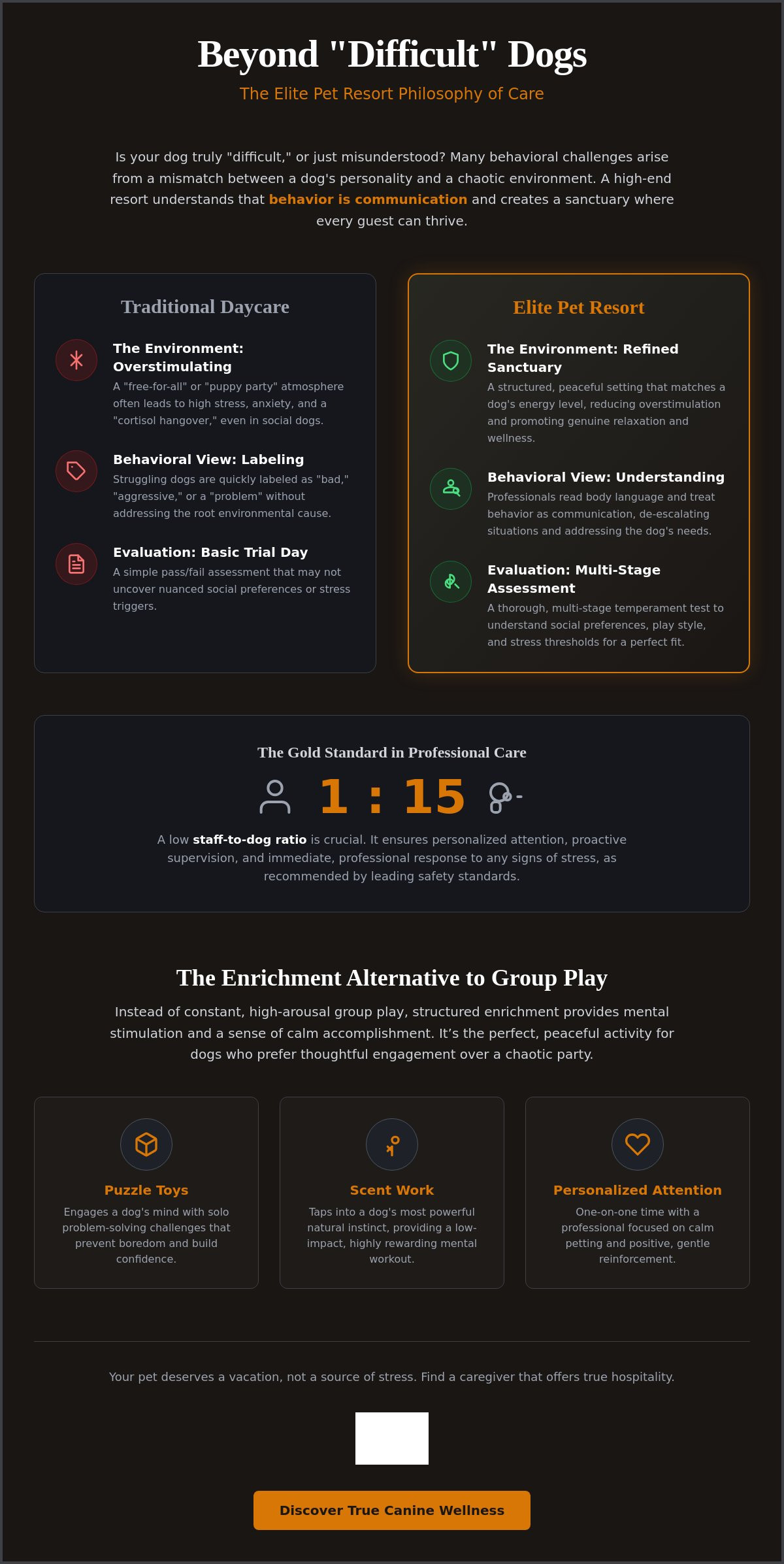
Traditional "free play" environments are often marketed as a canine paradise, but for many dogs, they feel more like a crowded subway station at rush hour. If your pet has been labeled as "difficult" in a standard setting, it's likely because their personality isn't a match for unguided, high-intensity group play. Many dogs don't need more physical activity; they need mental engagement. This is a critical pivot in how daycares handle difficult dogs. By moving away from the "bad dog" narrative, elite resorts offer a sanctuary through structured enrichment services that prioritize mental stimulation over sheer physical exhaustion.
The transition to a "Canine Wellness" mindset is about recognizing that every guest is an individual. An anxious or reactive dog who struggles in a pack of twenty often thrives when given the chance to focus on a specific task. This approach treats your pet with the dignity of a high-end guest rather than a problem to be managed. It's about providing a peaceful, tailored experience that respects their boundaries and celebrates their intelligence. If you're ready to move beyond the "free-for-all" model, you can explore our enrichment services to find a better fit for your pet's unique needs.
Tailored Enrichment Activities
High-intelligence breeds and sensitive personalities often act out because they are bored or overstimulated. Our Dog Concierge team replaces chaotic play with sophisticated activities designed to channel that energy into something positive. These include:
Nose work: Using a dog's natural scenting ability to find hidden treasures, which provides a deep sense of accomplishment.
Puzzle solving: Interactive games that challenge the mind and build social confidence in a controlled, one-on-one setting.
Individualized play: Focused attention from a dedicated caregiver that removes the pressure of navigating complex pack dynamics.
By engaging the brain, we naturally lower the cortisol levels that lead to "difficult" behaviors. A dog who has spent an hour solving puzzles is far more relaxed than one who has spent an hour defensively guarding their personal space in a crowd.
Wellness and Physical Therapy Integration
Sometimes, what looks like a behavioral issue is actually a cry for help. At our Canine Wellness Center, we recognize that physical pain is a common root cause of social reactivity. A dog with a stiff hip or a sore joint is much more likely to snap at a rambunctious puppy. By integrating Dog Rehabilitation Physical Therapy into a guest's stay, we can address these underlying issues. This holistic care plan is especially vital for senior guests or those recovering from injury. Improving a dog's physical comfort directly improves their social confidence, turning a "difficult" guest into a happy, relaxed member of our resort family.
Finding the Right Resort for Your Unique Dog
Your dog deserves a sanctuary, not just a holding space. Selecting the right environment requires looking past the front desk and into the heart of the facility's operations. A true resort-style environment feels serene, not chaotic. It's a place where the air is filled with calm energy rather than the frantic noise of overstimulated pets. Understanding how daycares handle difficult dogs starts with their physical layout. We believe in a non-containment philosophy because space and freedom are essential for mental health. When a guest has room to move and choose their own path, the tension that leads to "difficulty" often evaporates naturally.
Building a long-term partnership with your provider is the key to lasting success. You want a team that views themselves as an extension of your family; someone who listens to your concerns and celebrates your dog's progress. Ask potential facilities how they manage rest. A facility that doesn't prioritize quiet time is a recipe for stress and behavioral outbursts. You should also inquire about their staff-to-dog ratio. Industry experts recommend a ratio of at least one staff member for every fifteen dogs. This ensures every guest receives the high-touch care and professional supervision they require to stay safe and happy.
Red Flags to Avoid in Pet Boarding
Don't be swayed by facilities that rely solely on webcams to prove their quality. While cameras are a nice touch, they don't guarantee professional behavioral management or empathetic care. Watch out for overcrowded play yards where dogs are left to "sort it out" themselves. This is a significant red flag that leads to injuries and fear. A lack of a structured temperament assessment is another warning sign. If a facility is willing to take any dog without a thorough introduction, they aren't prioritizing the safety of the pack. You want a place that values the "vibe" of the group over the number of bookings.
The Tails On Trails Pet Resort Approach to Individualized Care
We've designed our resort to be a haven for every personality type, from the social butterfly to the sensitive soul. Our commitment to a stress-free, luxury environment means your dog is treated as a guest of honor. We know that some dogs need a different pace, and we're proud to offer a sanctuary that respects those boundaries. Our enrichment services cater to "difficult" personalities by providing the mental engagement and one-on-one attention that traditional models lack. Experience the peace of mind that comes with professional, empathetic care at Tails On Trails Pet Resort. We don't just watch your dog; we advocate for their happiness and well-being every single day. Your pet's comfort is our highest calling.
Elevate Your Companion's Social Experience
Choosing the right care for a high-needs pet shouldn't be a source of guilt or worry. As we've explored, the secret to how daycares handle difficult dogs lies in a commitment to seeing the dog behind the behavior. By prioritizing sophisticated de-escalation and providing an alternative to the traditional "free-for-all" model, elite facilities create an environment where every personality can shine. Whether your pet needs a quiet afternoon in a plush suite or the mental challenge of specialized enrichment, there's a place for them to feel safe and understood.
At Tails On Trails Pet Resort, we've spent years perfecting a model that treats every visitor with the hospitality of a high-end guest. Since 2021, our specialized Canine Wellness Center and non-containment philosophy have provided the ultimate comfort for local and visiting pets alike. You don't have to settle for a chaotic environment that leaves your dog stressed. Instead, choose a sanctuary of heartfelt warmth and professional expertise. Discover the Tails On Trails Pet Resort difference—where every guest is family. We're excited to welcome your companion to a stress-free experience they'll truly enjoy.
Common Questions About Professional Canine Care
What should I do if my dog is kicked out of daycare?
First, take a deep breath and let go of any guilt. Being asked to leave a traditional facility often just means the environment was a poor match for your dog's social maturity or personality. It's an opportunity to find a more refined setting that prioritizes individualized care. Look for a resort that offers specialized enrichment services or one on one sessions with a Dog Concierge rather than a high density play yard.
Can a reactive dog ever go to a pet resort?
Yes, reactive dogs can absolutely enjoy a luxury stay if the facility is designed for their needs. Many high end resorts offer private suites and personalized activities that don't require group interaction. By choosing a Canine Wellness Center that understands reactivity, your dog can receive the same level of hospitality and pampering as any other guest without the stress of a crowded pack.
How do I know if my dog is stressed at daycare?
Stress often shows up in subtle ways, such as excessive panting, hiding behind staff, or a frantic release of energy once they get home. A tired dog should be relaxed, not vibrating with nervous exhaustion. Professional caregivers will provide you with honest updates about your pet's emotional state. If your dog seems consistently overwhelmed, it's time to consider a more serene, low density environment.
Is it normal for dogs to get "time-outs" during group play?
In a professional setting, these aren't punishments but essential "cooling off" periods. This is a proactive strategy for how daycares handle difficult dogs by allowing them to reset their nervous system in a private, plush area. These short breaks prevent overstimulation and ensure that every guest remains in a calm, happy headspace. It's a hallmark of a high touch service model that values safety over constant activity.
What is the difference between a kennel and a luxury pet resort?
A traditional kennel focuses on basic containment and physical needs, often in a clinical or utilitarian environment. In contrast, a luxury pet resort emphasizes hospitality, comfort, and a non-containment philosophy. Resorts treat your pet as a family member, offering upscale lodging, gourmet treats, and a range of wellness services. The goal is to provide a vacation experience that mirrors the warmth of your own home.
How do professionals stop a dog fight before it starts?
The secret lies in active supervision and a deep understanding of canine body language. Experts look for stiffening, intense staring, or a high tail carriage that signals rising tension. By using body blocking and verbal redirection, staff can break a dog's focus before a conflict begins. This expert management is a key part of how daycares handle difficult dogs to maintain a peaceful, secure atmosphere for everyone.
Does my dog need a trial day before staying overnight?
A temperament assessment is a mandatory step for any high quality facility. This trial day allows us to ensure that your dog feels comfortable and safe in our resort environment. It's an essential safety protocol that protects your pet and ensures they'll be happy during an extended stay. Think of it as a brief "meet and greet" to guarantee a perfect match between guest and resort.
Can enrichment services replace traditional daycare for high-energy dogs?
Enrichment services are often more effective than hours of unstructured running. Activities like nose work, puzzle solving, and individualized play sessions provide mental stimulation that tires a dog out more thoroughly and safely. For high energy breeds, this focused engagement prevents the physical and mental "burnout" that can lead to behavioral issues in a standard group play setting. It's a more sophisticated way to meet their needs.


Comments