How to Know If My Dog Will Like Daycare: The Ultimate Readiness Checklist
- May 2
- 13 min read
What if your dog's workday could feel less like a long wait at the window and more like a curated getaway at a Vermont retreat? You want to hit the slopes at Mount Snow or enjoy a full day of leaf peeping without that heavy pit of pet parent guilt in your stomach. It's natural to feel uncertain about your pup's social skills or fear they'll end up stressed in a loud, cage-filled environment. You are likely asking how to know if my dog will like daycare because you want them to feel as pampered and secure as you do during your mountain vacation.
We believe that no animal deserves to spend their day in a wire cage; they deserve a second home that prioritizes their emotional well-being. This article will help you identify the specific personality traits and behavioral signs that indicate your dog will thrive in a luxury resort setting. We'll walk through our readiness checklist, which highlights how a tailored "social battery" approach helps the 85% of high-energy dogs who often struggle in traditional facilities. You'll gain the confidence to choose a premium environment where your dog returns home tired, happy, and ready for cuddles.
Key Takeaways
Spot the subtle home indicators, like excessive vocalization or "counter surfing," that suggest your pup is craving the high-energy enrichment of a resort setting.
Discover how to know if my dog will like daycare by decoding pro-social body language and determining if your dog is "socially motivated" or prefers the company of our Canine Concierge team.
Learn why the "no wire cage" philosophy and climate-controlled Pup Cabins are non-negotiable for maintaining your dog’s emotional well-being during their stay.
Prepare for your visit with a clear checklist of essential vaccinations and the basic command foundation needed to navigate a luxury social environment safely.
Understand the Trial Day evaluation process, where our professional staff monitors your dog’s first 90 minutes to ensure they feel secure and at home.
Table of Contents Recognizing the Signs: Does Your Dog Need a Daycare Outlet? Temperament and Body Language: Is Your Pup a Social Butterfly? Resort vs. Kennel: Why the Environment Matters The Ultimate Dog Daycare Readiness Checklist The Evaluation Process: Your Dog's First 'Resort' Day
Recognizing the Signs: Does Your Dog Need a Daycare Outlet?
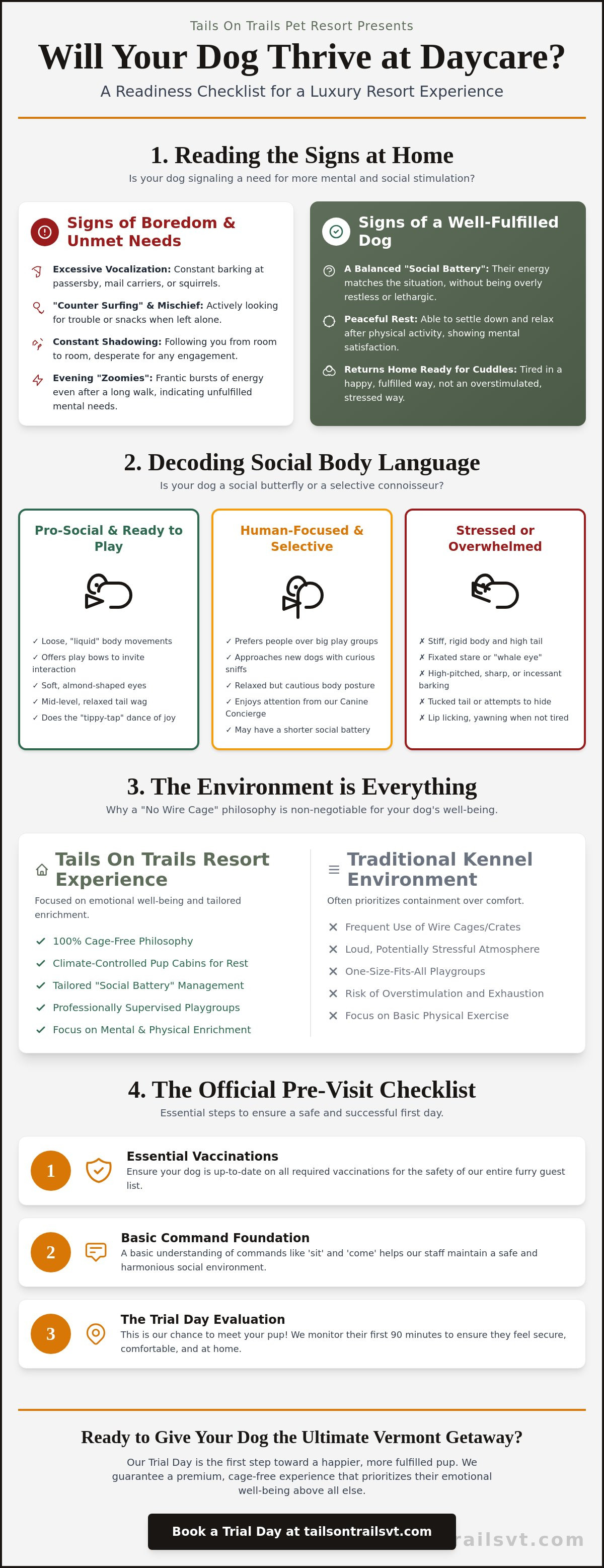
Doggy daycare is often misunderstood as a simple babysitting service for busy pet parents. At its core, a premium pet resort offers a highly structured social and enrichment program designed to stimulate a canine's mind and body simultaneously. While you're enjoying the slopes at Mount Snow, your pup should be experiencing their own tailored vacation. Understanding the nuances of how to know if my dog will like daycare starts with observing their daily rhythm at home. If your dog spends their afternoon "counter surfing" for snacks or engaging in excessive vocalization at every passerby, they're likely signaling a deficit in their social and mental needs.
Every dog possesses a unique "social battery." This internal capacity for interaction varies wildly based on breed genetics and individual personality. A young Labrador may have a battery that lasts for twelve hours of play, while a senior Basset Hound might feel fully charged after just twenty minutes of sniffing. The goal of a luxury environment is to match this energy level without causing overstimulation. There is a vital distinction between a dog who is physically exhausted and one who is mentally fulfilled. A dog can run for miles and still feel restless if their brain hasn't been engaged through problem-solving or social navigation.
Behavioral Red Flags at Home
It's essential to distinguish between true separation anxiety and simple boredom-induced mischief. Anxiety often manifests as destructive behavior focused on exit points like doors or windows. Boredom, however, looks like a dog who "shadows" you from room to room, desperate for any form of engagement. You might notice the "zoomies" hitting at 7:00 PM, even after a long evening walk. This frantic energy often indicates that their physical needs were met, but their social and cognitive needs remain untouched. When these behaviors persist, it's a clear sign that a structured outlet is necessary for their well-being.
The Socialization Gap
A standard leash walk provides great exercise, but it lacks the complexity of off-leash interaction. When dogs interact freely, they practice a sophisticated language of cues and responses. Gaining a deeper perspective on understanding dog behavior helps pet parents see that "dog-to-dog" communication is a pillar of cognitive health. Without this outlet, social skills can atrophy, leading to frustration or reactivity during random encounters. Canine enrichment is the purposeful stimulation of a dog's natural instincts. By providing these outlets, we ensure your pup returns home with a sense of peace and accomplishment rather than just a tired pair of paws.
Temperament and Body Language: Is Your Pup a Social Butterfly?
Determining how to know if my dog will like daycare requires a keen eye for the subtle nuances of canine communication. Pro-social dogs exhibit what our Canine Concierge team describes as "liquid" movement. Their bodies are loose, their eyes stay soft and almond-shaped, and they frequently offer play bows to invite others into their orbit. However, not every dog needs to be the life of the party to benefit from a resort stay. Some are "human-focused" and find more fulfillment leaning against a staff member for ear scratches than they do wrestling in a group. According to veterinary behaviorists on socialization, behavioral health is just as critical as physical health, as behavioral issues remain the primary cause of death for dogs under age three. Whether you're visiting Vermont for leaf peeping or a weekend on the slopes, your dog's social experience should be just as exclusive and tailored as your own.
The 'Tippy-Tap' Test
Observe your dog's "entry behavior" when you approach the gates of a new environment. Do they perform the "tippy-tap" dance with their front paws? Anticipatory joy is characterized by a wiggly butt, a mid-level wagging tail, and relaxed ears. This is a healthy, positive response. Contrast this with over-arousal, where a dog might fixate on the fence, bark with a sharp pitch, or show a stiff, high-held tail. Over-arousal is often a sign of underlying stress rather than true excitement. If your dog approaches with a curious sniff and a relaxed gait, they're likely ready for a day of premium play.
Understanding Dog Selectivity
When you're weighing how to know if my dog will like daycare, remember that "selective" doesn't mean "aggressive." In reality, dog selectivity is a normal developmental stage. As dogs mature past the 24-month mark, many move away from the "everyone is my best friend" puppy phase. They might prefer a smaller, curated playgroup of 4 or 5 calm companions rather than a high-intensity pack. This is why our environment completely rejects the chaotic "kennel" feel. By utilizing low-volume groups and private, climate-controlled Pup Cabins for essential rest, we allow "shy but curious" dogs to bloom without feeling overwhelmed. If you're ready to find a second home that respects your pup's unique social boundaries, learn more about our resort experience and how we tailor every stay to the individual.
Resort vs. Kennel: Why the Environment Matters
The difference between a standard boarding facility and a luxury pet resort is felt the moment you walk through the door. Most traditional "kennels" rely on high-volume warehouse models where 50 or more dogs are packed into a single, echo-heavy room. This environment creates a wall of sound that can spike a dog's stress levels within minutes. When you are researching how to know if my dog will like daycare, the physical environment is often the deciding factor. A boutique resort prioritizes a "no wire cage" philosophy, ensuring that your pup never feels like they are in a holding pen. Instead, we provide a second home that mirrors the comfort of your own living room, even while you're busy on the Mount Snow slopes.
Our resort model replaces cold concrete and chain-link fences with private, climate-controlled Pup Cabins. These spaces are essential for providing the rest periods that high-energy dogs often ignore on their own. In a warehouse setting, dogs are often forced to stay "on" for eight hours straight, leading to physical exhaustion without true mental peace. By contrast, a luxury facility uses lower staff-to-dog ratios to ensure every guest receives individual attention. This high-touch hospitality, led by a dedicated Dog Concierge, allows us to monitor each pup's happiness in real-time, preventing the "pack mentality" that often leads to scuffles in overcrowded spaces.
The Philosophy of Stress-Free Care
A second home atmosphere isn't just a luxury; it’s a biological necessity for reducing cortisol levels. In a serene, boutique setting, dogs don't feel the need to constantly guard their space. Structured downtime is built into the day, allowing guests to retreat to their Pup Cabins for a nap between play sessions. If you're still wondering how to know if my dog will like daycare, look at their sensitivity to noise and crowds. If they prefer a calm, predictable environment, they will thrive in a resort that values quality over quantity. Our Dog Concierge services ensure that playgroups are curated by size, temperament, and energy level, offering a tailored experience that one-size-fits-all facilities simply can't match.
Safety Standards in Premium Facilities
Safety in a luxury resort goes far beyond basic supervision. We maintain 100% climate control year-round to protect guests from the humid Vermont summers and the freezing winter chill. Our sanitation protocols exceed industry minimums, using hospital-grade cleaners that are 99.9% effective against common canine pathogens while remaining completely non-toxic. Professional staff are trained to recognize the earliest signs of over-stimulation, stepping in to provide a "decompression break" before a dog becomes overwhelmed. This proactive approach ensures that every guest remains safe, happy, and ready for a peaceful car ride home at the end of the day.
The Ultimate Dog Daycare Readiness Checklist
Determining how to know if my dog will like daycare requires more than a simple guess. It involves a systematic look at their current health, training foundation, and emotional maturity. Before you pack your bags for a weekend of leaf peeping or skiing, use this comprehensive checklist to ensure your pup is prepared for the high-touch environment of a luxury resort. A successful stay begins with a dog who is as physically ready as they are socially eager.
Health and Vaccination Status: Safety is our uncompromising priority. Every guest must be up to date on Rabies, Distemper (DHPP), and Bordetella. These aren't just suggestions; they are the baseline for communal health.
Basic Command Foundation: Your dog doesn't need to be a circus performer, but they should respond to "sit" and "come" even when distracted by new friends. This ensures our Dog Concierge team can maintain a peaceful flow during play.
Separation Threshold: Can your pup settle comfortably without you for 4 or more hours? If they can't relax in a private space at home, the transition to a resort environment might feel overwhelming.
Social History: Reflect on past experiences at local dog parks or private playdates. Dogs with a history of positive, loose-body interactions are the primary candidates for group play.
Resource Guarding: A ready dog is one who can share toys, water bowls, and physical space without showing tension or "guarding" behaviors toward other guests or staff.
Physical and Medical Readiness
Communal responsibility is a core value at our resort. All guests must be on a consistent flea and tick prevention program to ensure the facility remains pristine. For the youngest members of our pack, we require the completion of the full 16-week puppy vaccination series before their first visit. Additionally, spaying or neutering is required for most guests once they reach 6 to 10 months of age. This standard helps maintain a neutral, low-stress hormone balance within the playgroups, preventing unnecessary friction between dogs.
Social and Emotional Milestones
Emotional readiness is often about "bounce back" time. If a loud noise or a sudden movement occurs, does your dog recover within 30 seconds, or do they remain hider-bound for the rest of the hour? A resort-ready dog can also "read" the room. They understand when another dog gives a subtle correction signal, like a head turn or a stiffen, and they respect that boundary immediately. Finally, they must be comfortable with being handled by our professional staff. If your pup checks these boxes, they are ready to swap the "kennel" life for a true vacation. Book your pup's luxury stay today and give them the getaway they deserve.
The Evaluation Process: Your Dog's First 'Resort' Day
The final step in how to know if my dog will like daycare is our signature Trial Day. We view this as a low-pressure introduction to our second home rather than a high-stakes test. While you're enjoying a day of skiing or exploring the Vermont trails, our professional staff observes your pup's behavior in a controlled, luxury setting. We focus on the first 90 minutes of the stay, as this window provides the clearest picture of how a dog navigates new environments. During this time, our Canine Concierge team monitors stress signals, energy levels, and social curiosity to ensure the resort is a perfect match for their personality.
We utilize a "slow intro" method that completely rejects the chaotic pack-entry style used by traditional warehouses. We introduce your dog to one calm, socially savvy companion at a time. This one-on-one approach prevents the "group rush" that can overwhelm even the most confident dogs. A successful evaluation doesn't mean your dog played for eight hours straight. It means they showed a "social battery" that could recharge, used our Pup Cabins for a peaceful nap, and interacted with staff with soft, relaxed body language. If a dog doesn't pass, we don't view it as a failure. It simply means they might prefer a one-on-one care model or a quieter home environment, and we'll always provide 100% honest feedback to protect their well-being.
What to Expect During the Assessment
The process begins with a calm arrival where we meet you and your pup to discuss their history. We then move to a neutral zone for those critical first introductions. Throughout the day, we document their progress to share with you later. We believe in 100% transparency, which is why every Trial Day guest receives a detailed report card covering their social interactions and rest periods. An evaluation ensures the safety of all guests, not just your pup.
Preparing for the First Stay
To make the first drop-off as stress-free as possible, we recommend keeping your goodbye short and sweet. Dogs are experts at reading human emotions; if you're anxious, they'll feel it too. Give them a quick pat, hand over the leash, and head off to the slopes with peace of mind. Be sure to tell our Canine Concierge about any specific quirks, such as a preference for left-side ear scratches or a fear of shiny floors. These small details help us provide the tailored, premium experience your dog deserves. Ready to see if your pup loves the resort life? Book your evaluation stay today!
Give Your Pup the Vermont Vacation They Deserve
Finding the right balance between adventure and rest is the secret to a happy, well-adjusted dog. You now have a clear roadmap for how to know if my dog will like daycare, from decoding subtle body language to confirming their medical readiness. A true pet resort is more than just a place to stay; it's a second home where your pup's emotional well-being is the top priority. By choosing a boutique environment that rejects wire cages in favor of climate-controlled Pup Cabins, you ensure their time away is as restorative as your own trip to the Mount Snow slopes.
Our expert Dog Concierge staff provides the high-touch hospitality that transforms a standard day into a premium experience. We focus on small, curated playgroups and structured downtime to keep stress levels low and spirits high. You don't have to carry the weight of pet parent guilt when your family member is receiving professional care in a loving setting. We are ready to welcome your pup into our pack for a day filled with enrichment, safety, and joy.
Discover the Luxury Your Dog Deserves – Book a Daycare Stay
Frequently Asked Questions
Is my dog too old to start going to daycare?
Age is never a disqualifier as long as your dog remains healthy and socially curious. Many senior guests enjoy the gentle cognitive stimulation of a resort environment; it keeps their minds sharp while they watch the action from a comfortable distance. We monitor mobility levels closely and provide extra orthopedic bedding in our Pup Cabins to ensure older joints get the rest they need after a morning of light socializing.
What happens if my dog doesn't get along with others during the trial?
We prioritize safety above all else and provide 100% honest feedback if a dog isn't a fit for group play. If a pup shows signs of significant stress or defensive behavior, we stop the trial immediately to protect their emotional well-being. This isn't a failure; it simply means your dog might prefer the quiet of a private home setting or a one-on-one walking service instead of a busy social environment.
Can my dog go to daycare if they aren't spayed or neutered?
We require all guests to be spayed or neutered once they reach 6 to 10 months of age. This policy is a standard safety measure designed to keep the hormonal energy in the playgroups neutral and predictable. By maintaining this requirement, our Canine Concierge team can ensure that every interaction remains focused on play and companionship rather than instinctual friction.
How many days a week of daycare is best for most dogs?
Two to three days per week is the ideal frequency for 75% of our regular guests. This schedule provides a consistent social outlet while allowing for "recovery days" at home to prevent physical overexertion. High-energy breeds may thrive with four days of attendance, but we always monitor for signs of fatigue to ensure the experience remains a fun vacation rather than a stressful chore.
Will daycare make my dog more tired or more hyper at home?
A balanced resort day results in a "satisfied tired" rather than a frantic, hyperactive state. Hyperactivity at home often stems from over-stimulation in facilities that lack structured rest. Because we utilize private Pup Cabins for mandatory naps, our guests return home with their physical and mental batteries healthily drained, making them ready for a quiet evening of relaxation with their family.
What should I look for in a 'cage-free' facility to ensure it's safe?
Look for solid-walled rest areas and professional staff-to-dog ratios of at least one person per 10 to 15 dogs. "Cage-free" should never mean "unsupervised" or "unstructured." A premium facility will have clearly defined zones for different energy levels and a dedicated Canine Concierge team that understands the nuances of canine communication to prevent scuffles before they start.
My dog is shy; will daycare help them become more social?
Daycare can help a shy dog bloom if the facility uses a slow, curated introduction process. This is a vital part of how to know if my dog will like daycare; if the staff forces a shy dog into a large pack, it will likely cause a setback. We use one-on-one introductions with our calmest "ambassador" dogs to build your pup's confidence at a pace that feels safe and encouraging.
What if my dog needs a nap or a break during the day?
Structured rest is a mandatory part of every guest's daily itinerary at our resort. We believe that no dog should be forced to stand on their paws for eight hours straight. Our climate-controlled Pup Cabins provide a private, serene space where your dog can enjoy a high-quality nap, ensuring they stay refreshed and happy for their afternoon play sessions.


Comments